Zimbabwe lithium processing has reached a turning point. The government has banned raw ore exports, forced mining companies to refine the mineral on home soil, and positioned the country as one of the most important lithium producers outside Australia and Latin America.
On paper, that is exactly the kind of industrial policy Africa has needed for decades. But every major processing plant now under construction is Chinese-owned and Operated, and feeds directly into China’s battery supply chain. The companies now building the plants are the same ones that were shipping the raw ore out in the first place.
The script is familiar. African soil. Foreign capital. Foreign ownership. And just enough local activity to call it progress.
Zimbabwe is trying to tear up that script, and deserves credit for trying. But the full picture of what’s actually happening in the country’s lithium sector is more complicated than the government press releases suggest.
For years, Chinese firms extracted raw lithium ore from Zimbabwe and shipped it back to China for processing, with almost no value added in Zimbabwe. In response, Zimbabwe’s government compressed its lithium concentrate export ban from a planned January 2027 implementation to immediate effect on February 25, 2026, a 10-month acceleration that sent a clear signal that the era of exporting raw materials while someone else captures the profit is supposed to be over.
What Zimbabwe actually has
Zimbabwe now accounts for almost 10% of global mined lithium supply, making it one of the most significant producers outside Australia and Latin America.
The country exported 1.128 million metric tonnes of spodumene concentrate in 2025, an 11% increase from 2024. Total lithium-sector revenue reached $571.6 million in 2025, accounting for nearly 17% of Zimbabwe’s total mineral income.
That is not a junior player. That is a country sitting on some of the most strategically valuable ground on earth at precisely the moment the global economy is scrambling for battery materials. Mining as a whole contributes 14.3% of Zimbabwe’s GDP, making it the second-largest sector in the economy after manufacturing.
Clearly, Zimbabwe has leverage. The question is whether the country is using it.
Who is doing the processing?
Battery-grade lithium carbonate commands over $7,000 per ton on global markets, compared to just $570 per ton for raw concentrate. That gap is exactly why Zimbabwe’s beneficiation policy exists; processing the mineral domestically before export means capturing a far greater share of its value.
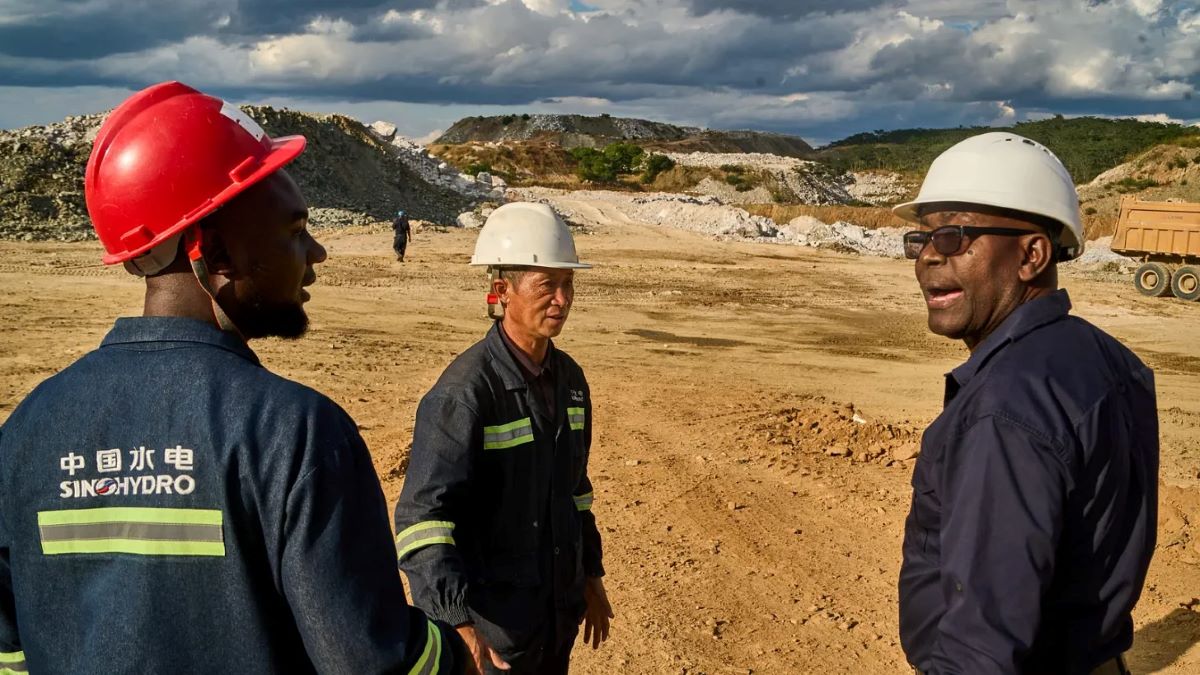
Zhejiang Huayou Cobalt‘s newly completed $400 million plant at the Arcadia mine is designed to produce more than 60,000 metric tons of lithium sulfate annually, with production beginning in early this year. Sinomine Resource Group has announced a $500 million processing facility at its Bikita mine. Sichuan Yahua Industrial Group has also broken ground on a third lithium sulfate plant, the third such facility being built by Chinese companies in Zimbabwe.
In total, Chinese investors are deploying $900 million into Zimbabwe’s lithium processing infrastructure.
That investment is building something real. But every one of those plants is Chinese-owned and operated, feeding into a supply chain that terminates in China’s battery manufacturing ecosystem.
DON’T MISS THIS: Botswana blue diamond discovery, and why the wealth isn’t staying in Africa
What the experts are saying
The debate among industry analysts is not whether this is progress; it is. The debate is about how much of that progress Zimbabwe actually controls.
Calisto Radithipa, founder of Kemcore, a mining supplier operating across southern Africa with a decade of experience in China, acknowledges the financial upside for Zimbabwe. “Lithium sulfate is of higher value than concentrates,” he told Semafor. “So already the government will earn higher royalties.”
But Gift Mehlana, president of the Chemical Society of Zimbabwe, offers a more cautious read. He notes that while Zimbabwe has a foundation of technical expertise, scaling that into large industrial refineries requires sophisticated process controls, operational experience, and environmental management systems that the country is still developing.
Higher royalties are not the same as industrial ownership. Zimbabwe earns more per ton, but the decisions about where that lithium goes, how it’s priced, and who it supplies remain in Chinese hands.
The deeper problem
According to Zimbabwe’s State of Mining Report, 99% of local miners are experiencing production stoppages due to power shortages, costing the sector an estimated $500 million in lost revenue. The country’s power deficit currently exceeds 1,000 MW, with the Kariba hydroelectric plant operating at just 185 MW of its 1,050 MW capacity.
That is the structural vulnerability sitting underneath all of these ambitions. You cannot run a lithium sulfate refinery without reliable electricity. And right now, Zimbabwe cannot guarantee it.
Chinese firms have already demonstrated a willingness to use that vulnerability as leverage. In 2024, Bikita Minerals, owned by Sinomine, reduced production and cut jobs, citing poor infrastructure and policy inconsistencies. The government responded by softening its approach, assessing the case-by-case nature of the beneficiation plans. That flexibility has inadvertently created openings for smuggling and corruption, patterns already visible in Zimbabwe’s diamond, gold, and chromium sectors, all of which are dominated by Chinese firms.
Progress, yes. Independence, not yet
None of this cancels Zimbabwe’s policy achievement. Banning raw ore exports in 2022 made Zimbabwe the first African country to implement that restriction, a move that has since influenced conversations across the continent. The accelerated concentrate ban in 2026 doubles down on that commitment.
But there is a material difference between hosting industrial activity and controlling it. With three processing facilities controlled by Chinese companies, Zimbabwe’s 10% global market share is now concentrated in a supply chain that increases rather than decreases dependence on a single foreign partner.
The US and Europe are watching. Both are actively seeking alternative supply chains to reduce dependence on Chinese battery materials, which could eventually give Zimbabwe room to diversify its partnerships and extract better terms. That geopolitical window is feasible, but it only opens if Zimbabwe builds the institutional capacity to negotiate from a position of strength.
Processing lithium inside Zimbabwe’s borders is a start. Owning the process is the goal. Right now, those are two very different things.
Follow BLKNOW for the stories behind the headlines: Instagram/X