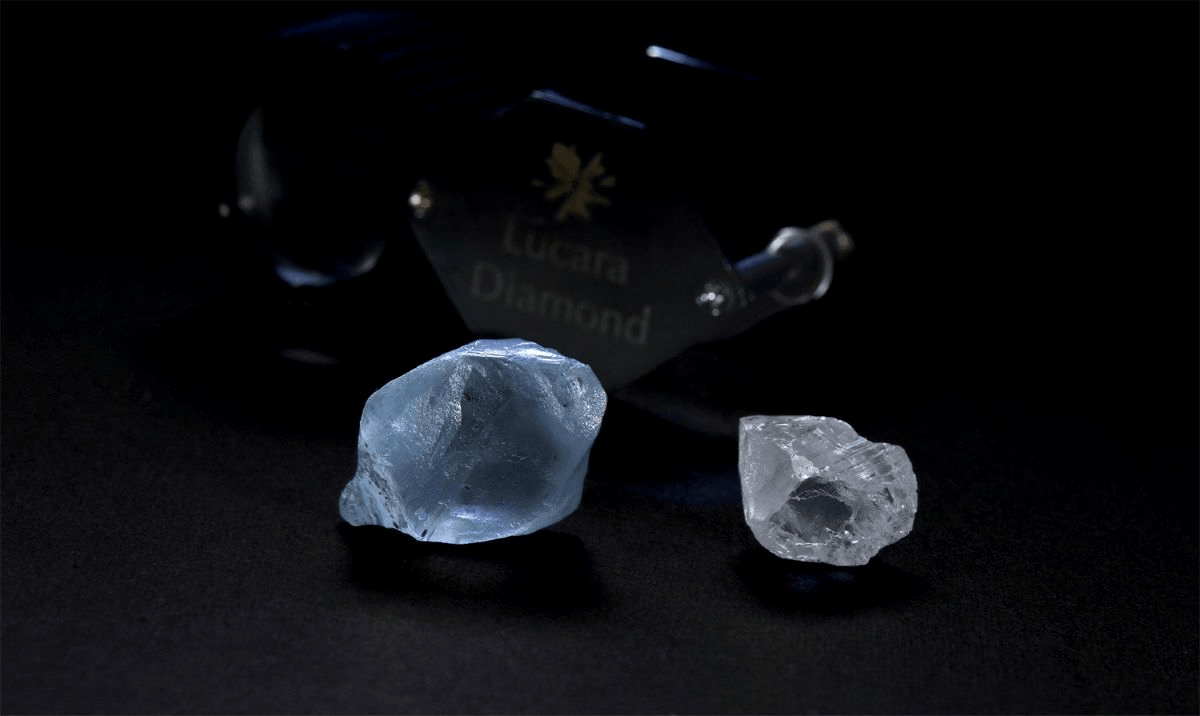
Canada’s Lucara Diamond has recovered a 36.92-carat blue diamond from stockpiled ore at its Karowe mine in Botswana, one of the rarest gemstone discoveries on the continent in years. Classified as a Type IIb diamond, the stone gets its blue colour from traces of boron, placing it among the most valuable gems on earth.
What makes this find particularly striking is how it was recovered. The diamond didn’t come from active digging; it was pulled from old stockpile material using X-ray transmission technology. Botswana’s ground had been holding this stone all along. Older equipment simply couldn’t find it.
“From the first moment we saw the diamond, it was clear we had something very special,” Sky News quoted Marcus ter Haar, the managing director of state-owned Okavango Diamond Company, which markets gemstones.
“It is incredibly unusual for a stone of this colour and nature to have come from Botswana – a once-in-a-lifetime find, which is about as rare as a star in the Milky Way.
“Only a handful of similar blue stones have come to market during the last decade, of which the Okavango Blue rightfully takes its place as one of the most significant.”
Botswana is the world’s second-largest producer of natural diamonds, behind Russia. This new diamond has not yet been valued, but in the past, a smaller gem found at the Karowe mine in 2016 sold for $63 million.
DON’T MISS THIS: Nigeria secures $1 Billion UK port deal, but at what cost?
Africa’s most productive diamond ground
The Karowe mine isn’t new to extraordinary finds. Since operations began, it has produced some of the world’s most significant diamonds, including the 1,758-carat Sewelô in 2019, the 1,109-carat Lesedi La Rona in 2015, and the 813-carat Constellation, also in 2015.
The name Karowe means “precious stone” in the local Setswana language. Botswana has always known what was in that ground. The mine produces roughly 300,000 high-value carats annually and remains one of the highest-margin diamond operations anywhere in the world.
Karowe is now transitioning from open-pit to underground mining, with full-scale underground production targeted for the first half of 2028. Feasibility studies project recovery of 4.5 million carats over a 10-year underground mine life. Billions of dollars worth of stones are still in Botswana’s earth.
The business reality behind the blue diamond headlines
The discovery is a complicated moment for Lucara, the Canadian mining firm at the centre of this story. The company’s revenue dropped 22% in 2025 to $159.7 million, while profit fell 35% to $26.1 million, a direct result of a weakening global diamond market and a dry spell of the large, premium stones that drive Lucara’s margins. This blue diamond is as much a financial lifeline as it is a headline.
For context, it’s only the second blue diamond of this significance Lucara has recovered at Karowe, following a 9.74-carat blue found in 2019. The stone’s final valuation hasn’t been confirmed, but Type IIb diamonds of this size routinely fetch tens of millions at auction.
Who really benefits from Botswana’s blue diamond?
Botswana has gone further than most African nations in reclaiming value from its mineral wealth. The government holds equity stakes in major mining operations, and the government has pushed hard to keep diamond processing, cutting, and trading on home soil rather than exporting raw stones for valuation abroad.
But the Canadian company still holds the licence at Karowe. A blue diamond worth potentially tens of millions just came out of the soil of southern Africa, and the story belongs to a Toronto Stock Exchange listing.
This is not unique to Botswana. Across Nigeria, across the continent, Africa’s mineral wealth continues to underwrite other economies while the host nations negotiate for scraps of equity and promises of jobs.
The blue diamond Botswana just gave the world is extraordinary. The conversation about who that wealth truly serves is overdue, and it isn’t going away.