Secondhand clothing from the West has destroyed Africa’s textile industry, and this outcome is far from accidental. Decades after the International Monetary Fund (IMF) and World Bank’s controversial programs weakened Africa’s manufacturing capacity, and after the secondhand clothing battle between East African nations and the United States, the continent now stands exactly where Western powers intended: dependent.
Adasu Inalegwu used to operate a loom, the machine that weaves thread into fabric.
For years, he worked at Arewa Textile mill in Kaduna, Nigeria, part of a workforce that, at its peak, numbered 5,000 people in that factory alone. When Arewa closed, Adasu moved to a one-bedroom house outside the city with his wife and eight children and bought a motorcycle. He now works as a commercial bike rider. His former factory stands empty. Grass grows through the floor. The machines were carted away for scrap.
Inalegwu’s story is one story. Multiply it by hundreds of thousands, and you have the story of African manufacturing in the second half of the twentieth century.
When Kaduna made cloth
There was a time when Kaduna was called the Manchester of Nigeria. The comparison was not flattering, but it was accurate. By the early 1980s, the city held 13 large textile companies along the Kakuri-Makera industrial axis: Kaduna Textiles Limited, United Nigeria Textiles, Arewa Textiles, Supertex, Nortex, Fintex and others. A single mill like UNTL employed over 10,000 workers. Landlords near the factories prospered. Food sellers, schools, transport operators, tailors, and cotton farmers across 30 states, an entire economic ecosystem, fed off those machines.
At its national peak, Nigeria had 180 textile mills employing up to 450,000 workers directly. The sector contributed roughly 25% of all manufacturing employment and was the second-largest employer in the country after the federal government. Those mills were also supported by 600,000 cotton farmers spread across 30 of Nigeria’s 36 states. The industry was not a sector. It was an economy within an economy.
By 2022, fewer than 20,000 jobs remained in Nigeria’s textiles sector. Between 1994 and 2005 alone, 64% of Nigeria’s registered textile companies disappeared, and 125 firms were reduced to 45. Employment fell from 137,000 in 1996 to 24,000 in 2008, and has continued to fall since. The factories that gave Kaduna its name are now ruins. A former KTL worker, speaking to a Nigerian journalist in 2017, described what remained:
“Go around and see what I am talking about. Apart from green grass and reptiles in these companies, there is nothing. The entire companies have been vandalised by hoodlums.”
Today, security analysts draw a direct line from the factory closures to the rise of banditry and kidnapping across Nigeria’s north. The jobs that once absorbed young men from across the region are gone. The land those factories sat on is rented by farmers to dry grain in the sun.
Nigeria is not an outlier. It is the clearest example of a collapse that ran across the continent.
DON’T MISS THIS: Julie Gichuru warns Africa is being recolonised: “We are going there”
Ghana, Kenya, Everywhere
Ghana’s textile story is structurally identical. In the 1970s, at its peak, the sector employed 25,000 workers across 16 medium-to-large factories and contributed 10 to 12% of GDP. By 2000, only three factories were still operating. Employment had fallen 80%. The companies that survived — Ghana Textile Printing, Akosombo Textiles Limited — are today shadows of what they were.
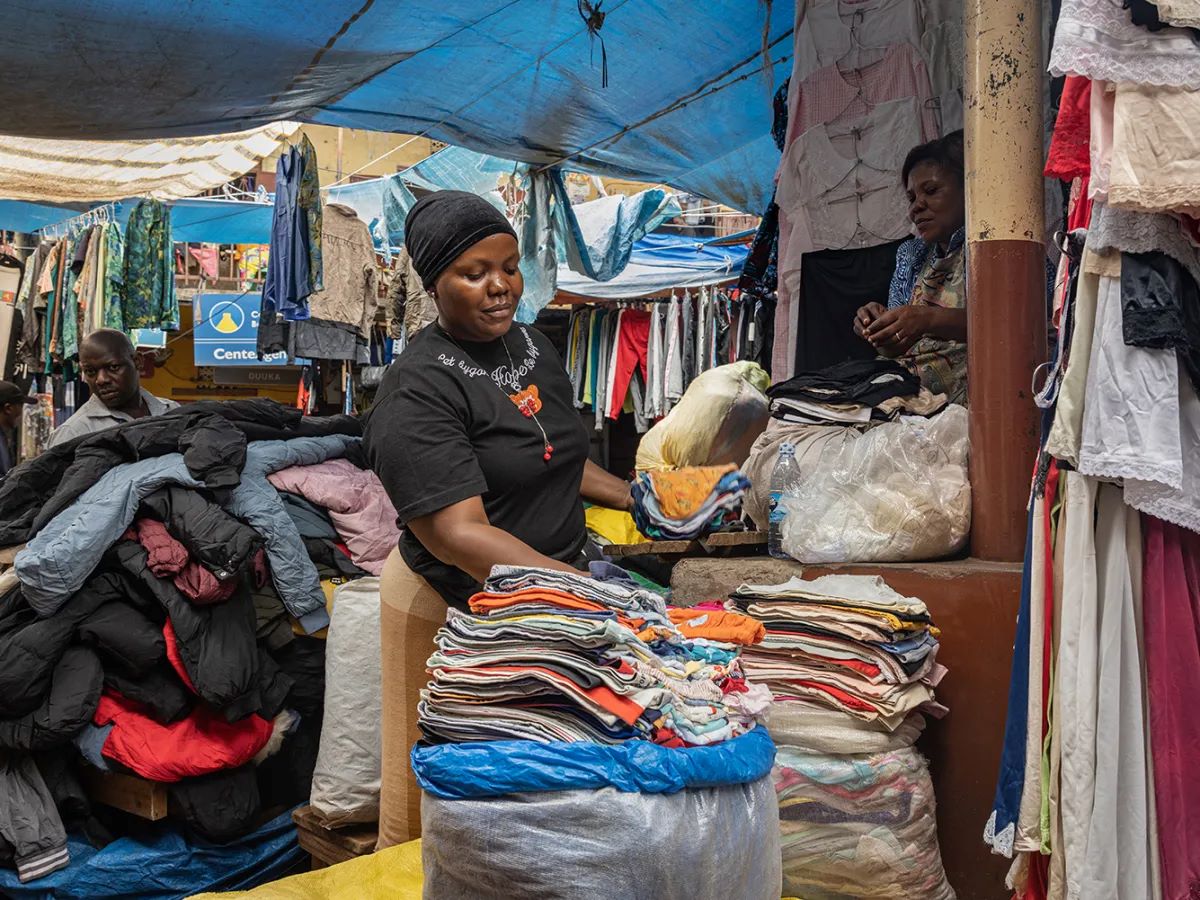
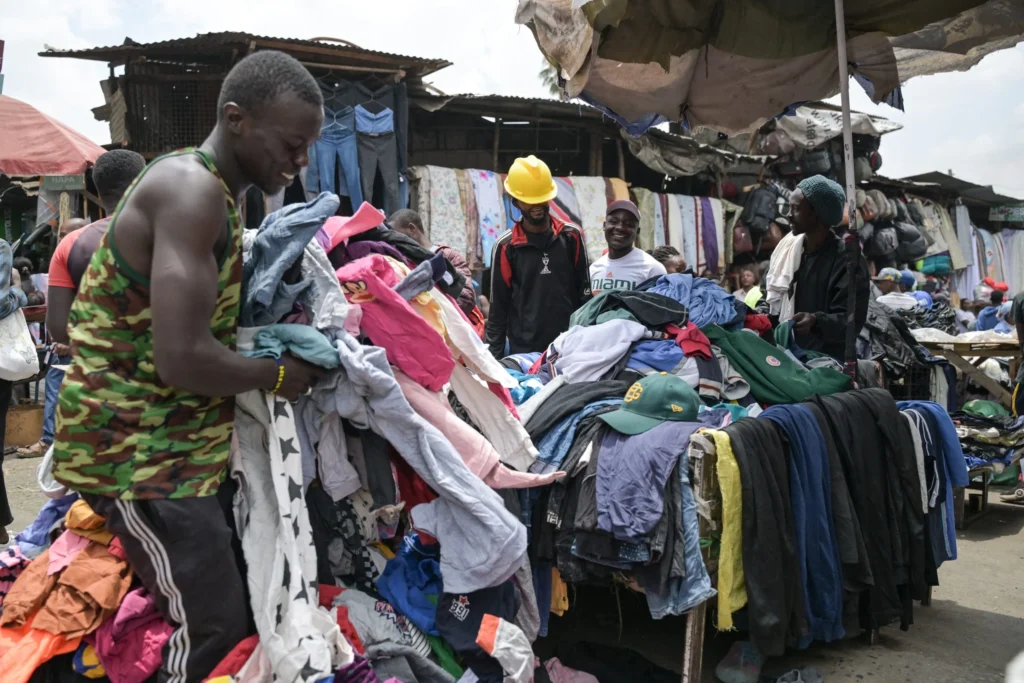
In Kenya, the secondhand clothing trade imported from the United States and Europe is called ‘mitumba,’ meaning bundles. In Ghana, it is ‘obroni wawu,’ meaning dead white man’s clothes. In Zambia, it’s called salaula, meaning to rummage through a pile. In Nigeria it is okrika.
The names are different but the market is the same: containers of used Western garments that arrive at African ports by the millions, sold at prices no local manufacturer can match because the goods cost almost nothing to produce. They are not produced at all. They are discarded. Someone in Chicago clears out a wardrobe. Someone in Accra sells the results from a stall.
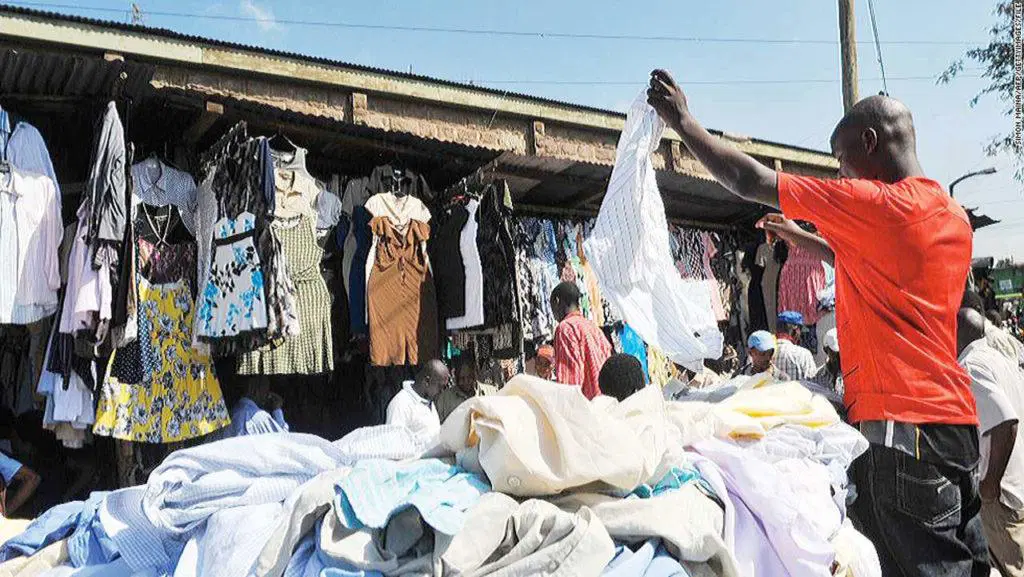
Kenya imported 184,000 tonnes of secondhand clothing in 2021. By the year ending March 2024, that figure had risen to 206,580 tonnes, a 14.5% year-on-year increase, worth $218 million. Ghana receives an estimated 15 million garments every week through the Kantamanto market in Accra alone.
What that volume does to local production is not difficult to model. A dress produced in a Nairobi factory carries the cost of Kenyan wages, electricity that includes diesel backup generation because the national grid cannot be relied upon, imported fabric, loan repayment at interest rates exceeding 20%, and transport to market. A dress from a secondhand bale costs the vendor almost nothing.
In a survey of Ghanaian fashion designers, 32% named cheap imported clothing as their single biggest competitive challenge. That number would almost certainly be higher if the question had been put to manufacturers. Most of the manufacturers are already gone.
How the industry was dismantled
To understand what happened to Africa, you have to start in 1948.
Europe had just finished destroying itself. Cities were rubble. Twenty million people had been displaced. The United States, surveying the wreckage and eyeing Soviet expansion, decided to help rebuild Europe industrially and systematically.
The U.S. government designed ‘The Marshall Plan’, a programme to rebuild Western Europe after World War II. The programme transferred $13.3 billion to 17 Western European nations over four years, equivalent to approximately $137 billion today. Much of that money went directly to rebuilding railroads, highways, bridges, and factories. It sent Europeans to the United States to study advanced industrial techniques. It funded machinery, fuel, and capital investment. By 1952, every recipient country had surpassed its pre-war GDP levels.
The explicit goal, as stated by the Economic Cooperation Administration, was to “restore industrial and agricultural production, establish financial stability, and expand trade.” Europe’s economic sovereignty was treated as a strategic priority.
Africa, in that same post-war period, was still colonised. By the time independence movements swept the continent in the late 1950s and 1960s, several things were already in place. The infrastructure built under colonialism was designed to extract resources, not process them. Railroads ran from mines to ports, not between cities. Trade patterns were wired to European capitals. And the international financial institutions that would govern global development — the IMF and the World Bank — were created by the same powers that had just colonised Africa.
Africa did not get a Marshall Plan. It got a structural adjustment.
Beginning in the 1980s, African countries facing debt crises were offered loans by the IMF and World Bank. The condition of those loans was a package of economic reforms known as Structural Adjustment Programmes (SAPs). African countries were told to privatise state enterprises, remove trade barriers, cut public spending, devalue their currencies, and eliminate subsidies.
The effect on the African industry was catastrophic.
SAPs forced African governments to remove the protections that had allowed infant industries to survive. When trade barriers came down, local manufacturers were suddenly competing against cheap imports from Asia and subsidised goods from Europe and America. Factories that had survived under protected conditions could not compete. They closed.
A peer-reviewed 1992 paper in World Development concluded directly that “IMF/World Bank prescriptions implemented through structural adjustment contributed to the destruction of the manufacturing base of African countries.”
Joseph Stiglitz, a former World Bank Chief Economist and Nobel Prize winner, later described the privatisation regime pushed through SAPs as “briberisation”, state assets sold at fire-sale prices to political cronies while manufacturing capacity was gutted.
The numbers tell the story. Africa’s share of global manufacturing output was over 3% in the 1970s. By 2024, it had fallen to under 2%. The contribution of manufacturing to Africa’s GDP declined from 12% in 1980 to 11% in 2013, where it has since remained frozen.
The Coalition of Closed and Unpaid Textile Workers in Nigeria claims that more than 3,000 former factory employees have died since the closures, many unable to afford the basic healthcare they could previously access through employment. Over 10,000 workers, the coalition says, remain unpaid their terminal benefits and gratuities. Those claims have not been independently verified, but no government body has disputed them.
The clothing war
Between 2016 and 2017, some East African countries — Kenya, Uganda, Rwanda, Tanzania, Burundi, and South Sudan — agreed to phase out the importation of secondhand clothing entirely by 2019 to revive their textile industries.
Rwanda moved fastest, raising import duties on used clothing from $0.20 per kilogram to $2.50. President Paul Kagame stated that his country had to choose between staying in the secondhand trade and building a garment industry. He called it a choice between dependency and dignity.
Within months, the Secondary Materials and Recycled Textiles Association, representing the American used-clothing exporters, filed a formal petition in Washington, D.C. Their argument was that the East African ban violated the terms of the African Growth and Opportunity Act and threatened American livelihoods, with about 40,000 US jobs at risk.
In response, the US government immediately imposed heavy trade sanctions on Rwanda and others.
Kenya, which exports nearly $600 million in goods to the US under the African Growth and Opportunity Act (AGOA) annually, reversed the ban decision months. Tanzania and Uganda formally committed not to implement the ban. In March 2018, the U.S government gave Rwanda 60 days to stand down. Rwanda refused. In July 2018, the US suspended Rwanda’s AGOA apparel benefits.
Rosa Whitaker, the first US Assistant Trade Representative for Africa, appointed under President Bill Clinton, called the American response “bullying.” That assessment came from inside the US trade establishment. It changed nothing.
Rwanda eventually retreated. That was how the East African initiative collapsed.
What the numbers mean
The arithmetic of what was lost is depressing.
A garment industry of any scale creates jobs at multiple levels simultaneously – factory workers, cotton farmers, dye producers, logistics workers, pattern cutters, quality control staff, and machine maintenance technicians. These are not informal jobs. They are formal, wage-paying, skill-building positions with multiplier effects through local economies.
Across the continent, the consequences are now measurable in a second generation of damage. Lesotho built its entire formal employment base around garment factories operating under AGOA preferences. The sector shed 16,000 jobs between 2018 and 2024 alone, with a further 20,000 now at risk as US tariffs tighten. The country’s prime minister told national television in 2025 that US policy had “crippled industries that previously sustained thousands of jobs.”
In Nigeria, 96.5% of textile products currently sold in the domestic market are imported, according to the Manufacturers Association of Nigeria. The country that once clothed itself and exported to West Africa now imports almost every thread it wears. The 600,000 cotton farmers who once supplied the mills no longer farm for domestic textile production. There are no mills left to supply.
FAQs
Why does secondhand clothing destroy Africa’s textile industry?
The price gap is unbridgeable by any legal means. A locally produced garment in Nairobi, Lagos, or Accra must recoup the costs of wages, energy, raw materials, financing, and logistics before it can be sold.
A secondhand garment from a Western donation pile was already produced and paid for by someone else. The African seller bought it by the kilogram. No local manufacturer can compete with goods that are free to make.
When this price gap exists at the volume Africa currently absorbs – Kenya alone imported over 200,000 tonnes in 2024 – local demand is structurally captured before domestic producers can reach it. The industry does not decline gradually. It loses its customer base and closes.
Does secondhand clothing hurt African manufacturing?
Yes. Ghana’s textile employment fell 80% between 1977 and 2000, the same period during which secondhand clothing imports accelerated following trade liberalisation.
Nigeria lost over 400,000 textile jobs across a similar period. Academic research published in World Development, the University of New Mexico Natural Resources Journal, and Springer Nature’s Discover Global Society (2025) all identify secondhand clothing imports as a primary factor in the decline of African garment manufacturing, alongside Chinese competition and poor infrastructure.
The argument that secondhand clothing supports African livelihoods through market trading is true but incomplete. It supports informal trading jobs. It eliminates formal manufacturing jobs. Those are not equivalent in terms of wages, skills development, tax contribution or economic multiplier effect.
What happened when Rwanda banned secondhand clothes?
In 2016, Rwanda led five other East African countries to phase out secondhand clothing imports by 2019. Rwanda raised import duties from $0.20 to $2.50 per kilogram, making it a prohibitive tariff. The goal was to grow a domestic garment industry.
The US-based Secondary Materials and Recycled Textiles Association filed a petition with the US Trade Representative arguing the ban violated AGOA eligibility criteria and threatened 40,000 American jobs. The USTR launched an eligibility review and threatened sanctions. Uganda and Tanzania backed down under the threat of losing AGOA benefits. Rwanda refused. In July 2018, the US government suspended Rwanda’s AGOA apparel export privileges. Rwanda eventually retreated from the policy.
Why Did Nigeria’s Textile Mills Close?
Nigeria’s textile industry began to collapse in 1986 when the IMF-mandated Structural Adjustment Programme removed trade protections that had allowed the sector to grow. The naira’s devaluation rendered foreign-currency loans unpayable. Open borders allowed smuggled Chinese textiles to capture an estimated 70% of the market. Counterfeit versions of popular Nigerian fabrics were produced in China at prices 80% lower than domestic mills could charge. Persistent power outages forced factories to switch to diesel generation, doubling energy costs. Interest rates of 32% made recapitalisation impossible.
KTL closed in 2002. Arewa, Nortex and several others followed between 2005 and 2007. By 2022, an industry that once employed 450,000 workers directly supported fewer than 20,000 jobs. 96.5% of textile products sold in Nigeria today are imported.