

The Alliance of Sahel States, a defense pact and confederation formed by Burkina Faso, Mali, and Niger, recently sent one of its most direct messages yet to the President Donald Trump administration – we are open to doing business with you, but on our terms.
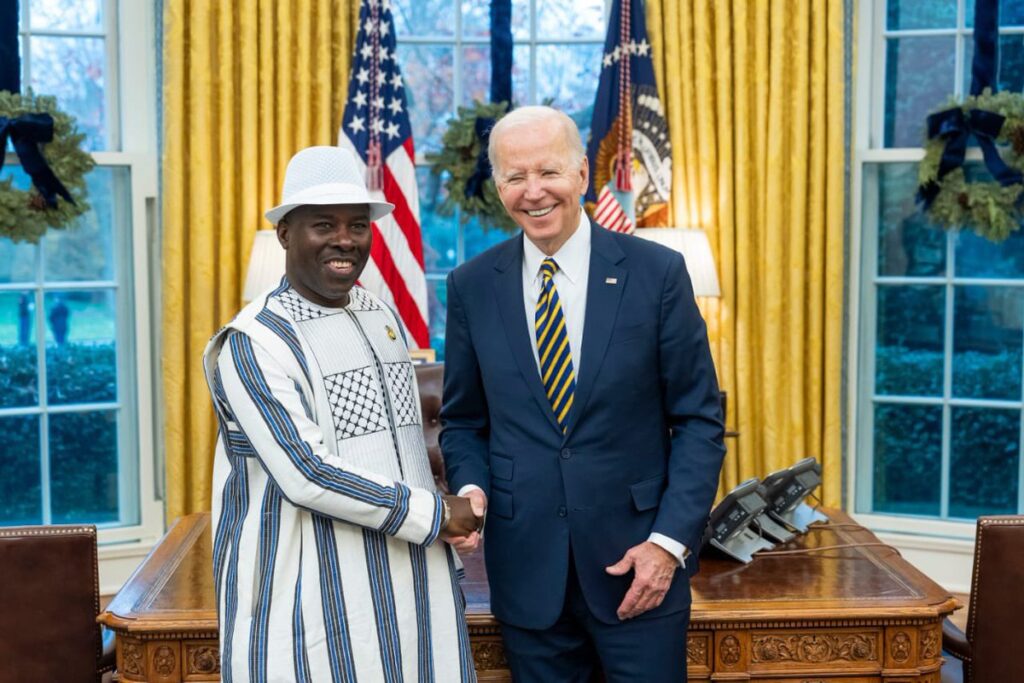
Mali’s ambassador to the United States, Sékou Berthe, on March 12 sat down at the Stimson Centre in Washington, one of the US government’s most influential policy think tanks, and did something African diplomats rarely do in that city. He told the truth. Directly. To the people responsible for the crisis in the Sahel region.
The conversation, which was part of the Stimson Center’s ambassador series, was moderated by Hafed Al-Ghwell, senior fellow and director of the North Africa program. And what Ambassador Berthe laid out over the course of that discussion was a precise, composed dismantling of the narrative the West has been selling about the Sahel for over a decade.
It all started in Libya…
In his opening remark, the ambassador immediately assigned responsibility.
“You know that we have been a victim of terrorism for more than 10 years now. Since the fall of Libya when Gaddafi was taken down in 2011 by NATO forces, and that cost a lot to our different states – Burkina, Mali and Niger – and that’s the consequence of Gaddafi’s death in the region that we are suffering of today,” he said.
On October 20, 2011, Muammar Gaddafi was killed near Sirte, Libya. He was captured alive after his convoy was struck in a NATO air strike, then beaten and killed by Libyan National Transitional Council (NTC) rebel forces. But the clinical summary of that day reveals a more important truth – Gaddafi’s fall was not simply a Libyan revolution. It was a Western-backed regime change operation.

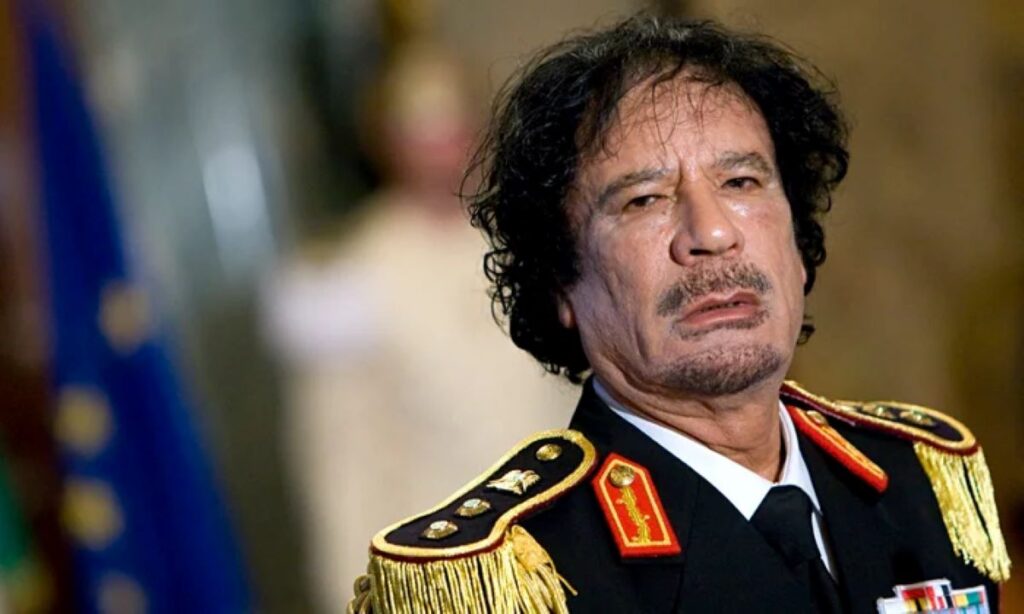
The United States, France, and the United Kingdom provided the air power, intelligence, and political cover that made Gaddafi’s fall possible. The Barack Obama administration authorised US military involvement under the justification of protecting Libyan civilians. NATO flew over 26,000 sorties. American drones and warplanes targeted Gaddafi’s forces directly. Without Western intervention, the NTC rebels would not have prevailed.
What followed was entirely predictable – and entirely ignored.
Libya had been one of the most heavily armed states in North Africa. When the regime collapsed, its weapons stockpiles — surface-to-air missiles, artillery, small arms — were left unsecured, available to anyone willing to move fast. Thousands of fighters who had served in Gaddafi’s security apparatus, including a significant number of Malians and Tuareg mercenaries, returned home armed and without a state structure to reintegrate into.
They moved south. Into Mali. Into Niger. Into Burkina Faso.
The Tuareg rebellion that erupted in northern Mali in 2012 was directly supplied by weapons that had poured out of post-Gaddafi Libya. From that rebellion grew the jihadist networks — AQIM, JNIM, ISGS — that have since killed tens of thousands of civilians and displaced millions across the Sahel. The instability that Western governments later deployed thousands of troops to “manage” was instability that their own decision created.
The ambassador was standing in Washington, the capital of one of the governments that authorised that intervention, telling them plainly: you did this.
20,000 foreign troops for 10 years
The second point was just as direct. Amb. Berthe described the years of Western military presence, French operations, American support, and European deployments and delivered a single devastating verdict:
“When we have more than 20,000 foreign troops settled in Mali for more than 10 years, coming to help fight against terrorism, instead of terrorism going down, it was growing.”
That sentence should end the debate about whether the Western military strategy in the Sahel worked. It didn’t. France alone had thousands of soldiers deployed through multiple operations across the region, yet by 2020, jihadist violence had expanded far beyond its original geography, spreading deeper into Burkina Faso, Niger, and towards coastal West Africa.
In the face of the escalating terror, the Malian government drew the only logical conclusion. If the presence of 20,000 foreign troops correlated with the growth of terrorism, not its decline, then those troops were not solving the problem. In 2020 and 2021, Mali went through two coups. The military government that emerged, led by General Assimi Goïta, expelled French forces and demanded sovereignty over their own security. The ambassador framed it this way:
“We took that decision in the name of sovereignty because we want to take our fight in our own. I think every country will do that. No country wants to outsource its security to another. That’s not sovereignty — that will be something else.”

‘We’re not in bed with Russia’
Here is where the ambassador’s Washington audience needed to listen most carefully, because this is the argument that is most often misrepresented in Western media.
“There has been a narrative going on that we kicked out one (France) and brought another one (Russia). So I think that’s a misinterpretation of the fact.”
His account of what actually happened is specific and verifiable. Mali, facing an existential security crisis, needed military equipment. They came to the United States first. Washington didn’t deliver. So they went to Russia, which sold them weapons and sent trainers to teach them how to use the weapons they bought, which is standard practice in any arms deal.
“We came here to the US first. We didn’t get any help. It’s not free — they don’t provide us with equipment for free; we buy it with our money. So we went to Russia, and luckily they sold us some military equipment so we can fight against terrorism,” the ambassador said explicitly.
What the Alliance of Sahel States is building
Perhaps the most underreported part of the ambassador’s Washington statement was his description of what the Alliance of Sahel States is actually building.
Mali, Burkina Faso, and Niger are not simply a military coordination bloc borne out of post-coup isolation. The ambassador described a confederation with a shared passport, a shared currency, a shared flag and anthem, a rotational presidency, currently held by Burkina Faso after Mali’s inaugural term, and a $1 billion confederation investment bank capitalised entirely by the three member states, with no foreign capital.
“The objective of the confederation is finally to come to a federation, as you have here in the US.”
He pointed at the American federal model as the blueprint for what the Sahel is attempting to build. In January 2025, all three member states formally withdrew from ECOWAS, accusing the bloc of serving foreign interests rather than African ones. The AES is not a temporary arrangement. It is a state-building project.
DON’T MISS THIS: Nigeria secures $1 Billion UK port deal, but at what cost?

Mali’s economy is not what the headlines suggest
The ambassador also addressed Mali’s resource wealth directly, and what he described repositions the country entirely in the geopolitical imagination.
“Mali today is a country very rich mineral-wise. We have gold, cotton, lithium, hydrogen, and oil. We are the second- or third-largest producer of gold in Africa. First producer of cotton in Africa, and of good quality, more than Egypt.”
Mali rewrote its mining code after the new government assessed that the previous framework was not benefiting the Malian people. Fourteen international mining companies are currently operating under the new terms. Barrick Gold, a major Canadian mining company operating in Mali, initially resisted and took the government to international arbitration, but later settled and aligned with Mali’s new mining policy.
The ambassador confirmed that Mali now has good standing with both the International Monetary Fund (IMF) and the World Bank, a detail that directly contradicts the narrative that the Sahel governments have broken up entirely with the global financial system.
Washington is now asking for a second chance
This is the detail that tells you everything about how power actually functions. The Joe Biden administration sanctioned Malian military officers following the coups. Those sanctions created a diplomatic freeze. The Trump administration lifted them. And now, according to the ambassador, talks are quietly underway to restore security cooperation, particularly in intelligence sharing.
“There are talks underway on security cooperation with the US. Nothing is finalised yet.”
Washington is not returning to Mali out of principle. It returned because the Sahel sits on gold, lithium, uranium, and hydrogen, and Chinese and Russian companies are already at the table. The ambassador made this calculation explicit and extended an open invitation:
“US companies are welcome to do business in our confederation. We have lithium, gold, uranium, hydrogen — a big deposit and oil. I want them to come earlier than later because there are other countries waiting to grab, to come and sign deals with us.”
He is right. And Washington knows it.
What this conversation actually means
An African ambassador walked into one of Washington’s premier policy institutions and reframed the entire Sahel crisis as it is – the truth without mincing words or being diplomatic. He did not come to apologise for his government’s decisions. He did not seek validation. He presented Mali’s position as sovereign, logical, and open to engagement on equal terms.
The civil society question on whether Mali’s military government has restricted political freedoms under the cover of security remains legitimate and unresolved. The ambassador dismissed those concerns as misinterpretation. That answer deserves scrutiny. Sovereignty rhetoric from a military junta is not the same as accountability to the people being governed.
Both truths must be held simultaneously. The West’s record in the Sahel is indefensible, and the governments now asserting sovereignty have their own democratic deficit to answer for.
Follow BLKNOW for the stories behind the headlines: Instagram/X